

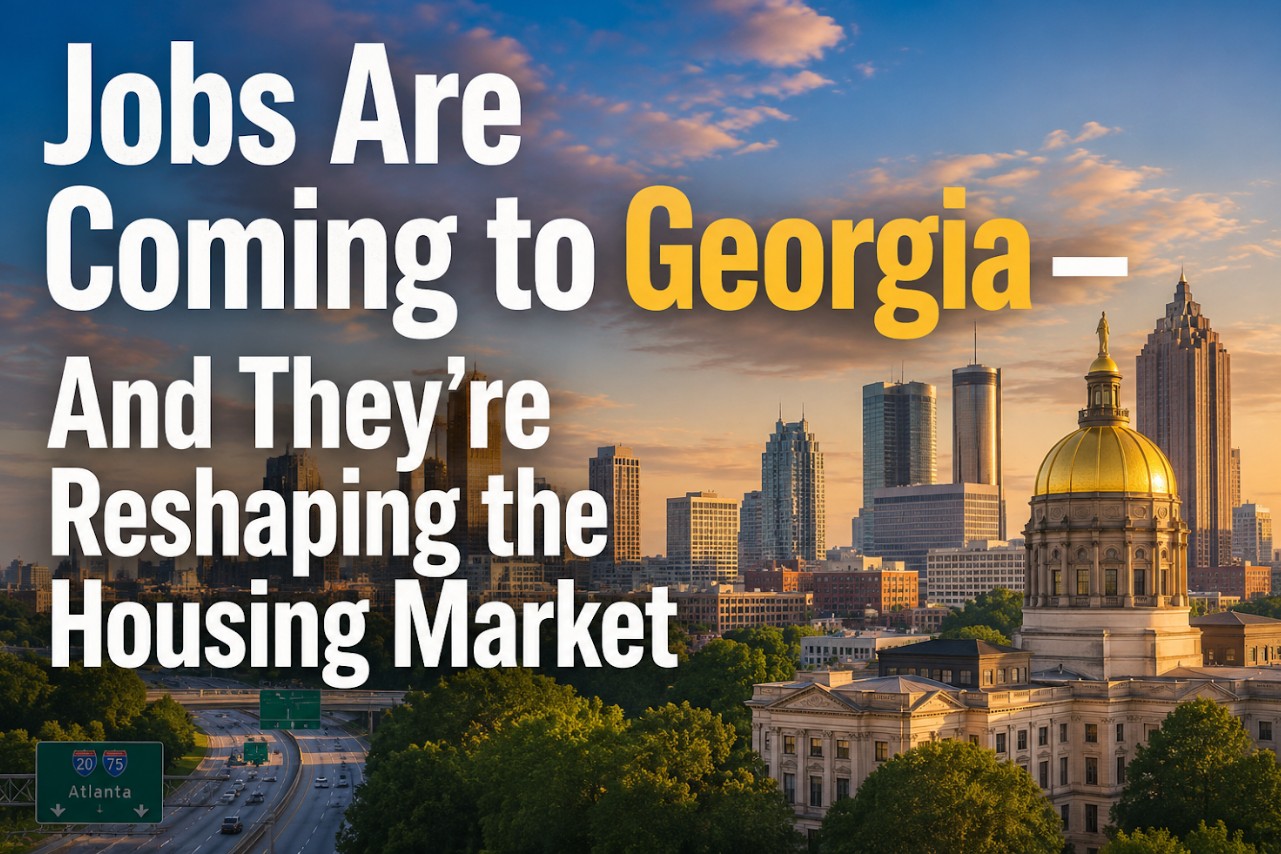
If you want to understand where Georgia real estate is headed over the next few years, don’t start with mortgage rates or listing prices. Start with paychecks. Every new job that lands in the state — whether it’s on an EV assembly line, in a hospital, or behind a laptop at a professional services firm — eventually shows up as a new renter, a new buyer, or a new investor competing for the same finite pool of homes. Right now, Georgia has a lot of new jobs coming.
The State’s Job Engine Is Revving Back Up
After a sluggish 2025, in which Georgia added only about 41,900 jobs — roughly half the pace seen from 2017 to 2019 — economists are expecting a real turnaround. Georgia’s job growth is forecasted to accelerate significantly, with the state expected to add 65,800 jobs in 2026 and 83,300 in 2027, and the Atlanta metro area alone accounting for more than 60,000 of those 2026 jobs. That acceleration is projected to help the state’s economy grow 5.5% in 2026, outpacing the national average.
What makes this growth story compelling for real estate isn’t just the number of jobs — it’s the diversity of where they’re coming from. Three sectors stand out.
1. The EV Industry Is Building Real, Physical Infrastructure
Georgia has spent the last few years positioning itself as an electric vehicle manufacturing hub, and 2026 is shaping up to be the year that bet starts paying off. Hyundai has already opened its EV assembly plant in Bryan County, and Rivian is moving forward on its multi-billion-dollar manufacturing facility, with the first phase of construction expected to begin this year.
This matters for housing in a very concrete way: EV plants don’t just create assembly-line jobs, they pull in an entire supporting ecosystem — suppliers, logistics firms, technical trainers, and skilled trades. Georgia Piedmont Technical College and veteran training programs are already expanding to prepare workers for EV maintenance and advanced vehicle software careers, and Rivian is funding tuition assistance and scholarships at Georgia Tech and UGA to build a long-term talent pipeline. A Georgia State University marketing professor put it simply: the state already has the university ecosystem and tech talent needed to support these manufacturers — the jobs are following the infrastructure that’s already in place.
For real estate, this translates into durable demand in specific submarkets — particularly around Bryan County (Savannah area) and wherever Rivian’s plant ultimately ramps up hiring. Manufacturing jobs tend to anchor working- and middle-class housing demand in ways that are stickier than remote-work-driven migration, because employees generally need to live within a reasonable commute of a physical plant.
2. Healthcare Is Quietly the Biggest Long-Term Driver
While EVs get the headlines, healthcare may be the more powerful long-run force. Economists highlight higher demand for healthcare, education, and business and professional services as major growth areas for 2026, and are unusually bullish on the outlook for Georgia’s large healthcare industry specifically, expecting continued job growth. The reasoning is demographic, not cyclical: Georgia’s population is aging, and as more baby boomers reach the age where heart attacks, strokes, and cancer become more common, the state will need more nursing facilities, residential care facilities, and hospitals to meet that demand.
Unlike a manufacturing boom, healthcare job growth is spread across the entire state — every metro area and many rural counties have hospitals and care facilities that need staffing. That means the housing impact isn’t confined to Atlanta; it shows up in demand for homes near hospitals and care campuses in Savannah, Columbus, Augusta, and beyond. It’s also a sector that tends to be recession-resistant, which gives homebuilders and investors more confidence that demand near major health systems won’t evaporate in a downturn.
3. Professional Services and Corporate Headquarters Keep Atlanta a Magnet
Atlanta’s economic base has always been broad — finance, technology, film, and logistics all support the metro’s job market, which is part of why demand doesn’t depend on any single industry the way some Sun Belt cities do. That diversity gets reinforced by Georgia’s remarkable concentration of corporate headquarters: The Home Depot, UPS, Delta Air Lines, the Coca-Cola Company, and Southern Company are the five largest firms headquartered in the state, and 34 metro-Atlanta-headquartered companies rank among the Fortune 1,000. Two more companies, Bakki Holdings and Vestis, joined that list in 2025.
Corporate headquarters generate a multiplier effect that’s especially relevant to real estate: they don’t just employ people directly, they attract law firms, consultancies, accounting practices, and other professional services firms that want to be close to their clients. That steady influx of white-collar jobs is a big reason the Atlanta Regional Commission projects the region will add 840,000 jobs through 2050 — a number that underpins long-term housing demand projections for the entire metro area regardless of short-term rate cycles.
What This Means for Buyers, Sellers, and Investors
Put together, these three trends explain why most forecasters don’t see a Georgia housing crash coming, even with affordability pressures still weighing on the market. A few practical implications:
- Buyers competing in submarkets near EV plants, major hospital systems, or corporate campuses should expect steadier demand — and less room for aggressive lowball offers — than in areas without a clear local job driver.
- Sellers in those same areas have a genuine tailwind, but shouldn’t assume it means a 2021-style bidding war; the broader market is normalizing, with more balanced negotiating conditions than in recent years.
- Investors are being encouraged to focus on properties in areas with strong employment centers and limited new construction to maximize rental performance, rather than chasing markets on price alone.
The throughline across all of this is that Georgia’s real estate market in 2026 is being shaped less by speculation and more by fundamentals — real jobs, in real industries, landing in specific places. That’s a healthier foundation than the pandemic-era frenzy, even if it means a more measured pace of appreciation for anyone hoping for another 2021.
Sources: RealWealth, Metro Atlanta CEO, Savannah CEO, Athens CEO, The Current GA, WABE, Savannah Business Journal, DealMachine.