

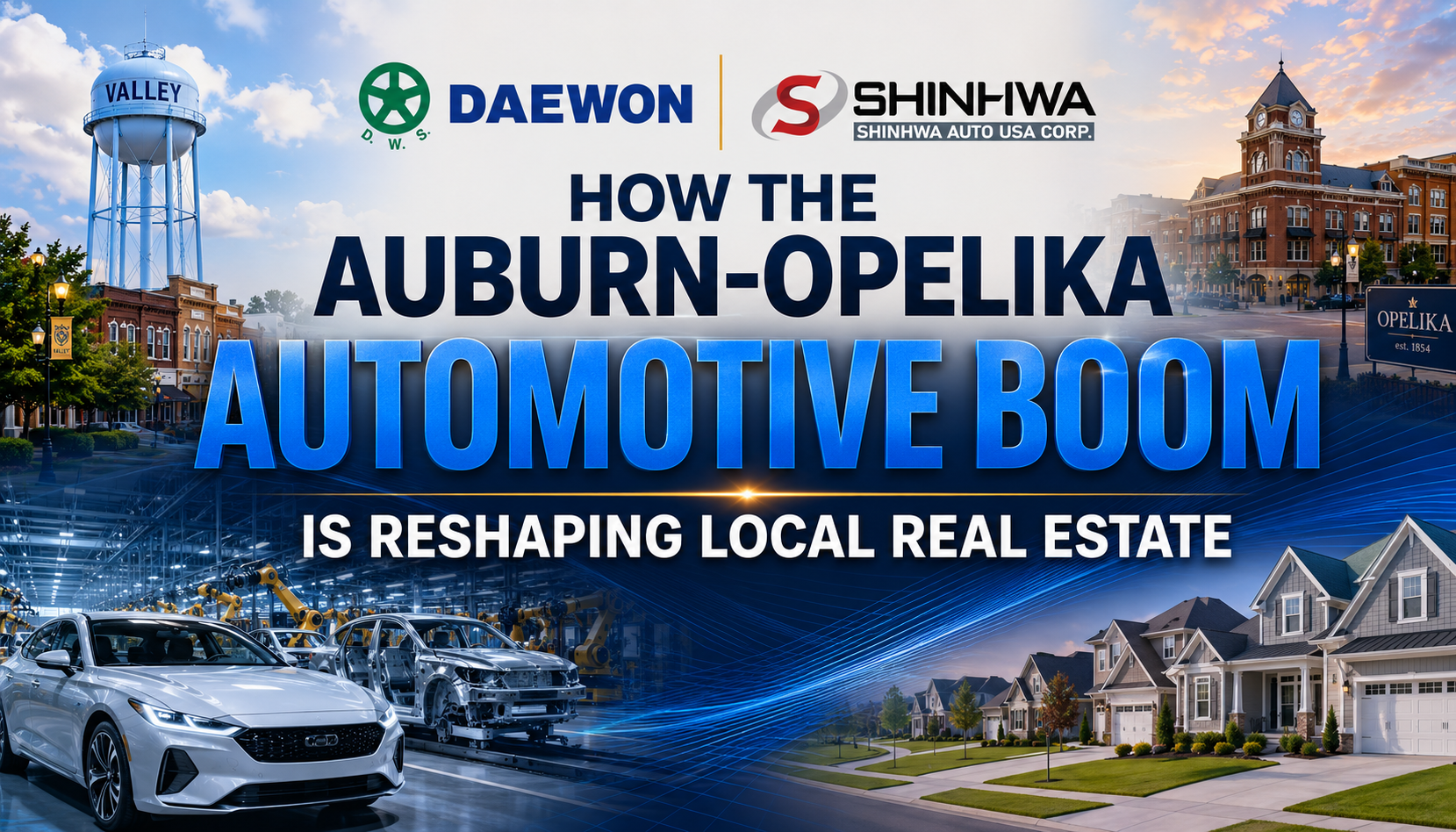
If you’re buying, selling, or investing in the Valley-Opelika-LaFayette corridor, there’s one economic story you can’t afford to ignore: the automotive supply chain is expanding fast, and it’s bringing housing demand right along with it.
The Investments Driving the Story
Two recent announcements out of the Auburn-Opelika area show just how much momentum this region has picked up:
- Daewon America Inc. is investing $46.2 million to expand its manufacturing facility in Opelika’s Northeast Industrial Park, adding new equipment and roughly 100 new jobs, with completion expected in 2027.
- Shinhwa Auto USA Corp. is putting $114 million into expanding its facility in Auburn Technology Park West, including a brand-new 170,000-square-foot production building.
These aren’t isolated projects. They’re part of a much longer pattern of automotive suppliers — including Donghee America, Seohan Auto/NTN Driveshaft USA, SCA Inc., Pyongsan America, Daewon America, and Arkal Automotive USA — choosing to invest and reinvest in this corridor because it already has the supply chain, the workforce pipeline, and the logistics access that automakers depend on.
Why This Matters for Real Estate
Every one of these expansions has a ripple effect that reaches straight into the local housing and commercial property market:
1. New jobs mean new households.
A combined 100+ new manufacturing jobs (and the supporting roles that come with them — logistics, maintenance, management, local suppliers) don’t just appear in a vacuum. Workers need somewhere to live. Many will relocate from outside the area, and even local hires often trade up or move closer to their new job site. That’s steady, built-in demand for starter homes, rentals, and move-up properties across Opelika, Auburn, Valley, and the surrounding Chambers and Lee County communities.
2. Industrial investment signals long-term confidence.
When a company sinks $114 million into a new production building, it’s not making a short-term bet — it’s planning for years of operations. That kind of capital commitment tells real estate investors and developers that the local economy has staying power, which makes it easier to justify new subdivisions, apartment developments, and commercial buildouts nearby.
3. Industrial parks pull rooftops with them.
Facilities in the Northeast Industrial Park and Auburn Technology Park West don’t operate in isolation — they draw suppliers, contractors, and service businesses that want to be close by. That’s part of why Chambers County is currently in a housing construction boom, with more than 10 subdivisions and roughly 600 new homes planned. Industrial growth and residential growth tend to move together.
4. Rental and workforce housing demand rises first.
Before someone commits to buying a home in a new area, they typically rent. As these facilities ramp up hiring through 2026 and 2027, expect increased interest in rental housing, especially in Opelika and Valley, which sit closer to the industrial parks than some of the higher-priced Auburn neighborhoods. This is a strong window for investors considering rental properties or landlords weighing whether to expand their portfolios locally.
5. Commercial and retail follow rooftops.
More workers and more households support more everyday retail, restaurants, and services. As new employees settle into the area, expect continued interest in retail and mixed-use commercial space along key corridors — the kind of ripple effect that’s already playing out with new restaurants, retail openings, and hotel investment across the broader Auburn-Opelika metro.
What This Means If You’re Buying, Selling, or Investing
- Buyers: If you’re planning to move to this area for one of these jobs (or simply want to be near steady employment growth), it’s worth acting with some urgency — well-priced homes near Opelika’s industrial corridor have been moving quickly.
- Sellers: Homes positioned near employment centers, with easy commutes to the Northeast Industrial Park or Auburn Technology Park West, may see stronger buyer interest as hiring ramps up.
- Investors: Rental demand tied to new manufacturing jobs is a classic early-stage signal. Getting into workforce housing or small multi-family properties now, ahead of the 2027 completion timelines, could pay off as these facilities reach full staffing.
- Developers: The combination of industrial investment and a documented housing construction boom in Chambers County suggests there’s real appetite — and real need — for new subdivisions and rental communities in the near term.
The Bigger Picture
Daewon America and Shinhwa Auto USA are just the latest chapters in a much longer story of automotive supply chain growth across the Auburn-Opelika metro. Combined with steady population growth, relocation demand tied to Auburn University, and a broader statewide wave of industrial investment, the fundamentals point to continued housing demand across Valley, Opelika, and LaFayette for the next several years.
For anyone thinking about real estate in this corridor — whether that’s a first home, a rental property, or a commercial investment — the automotive expansion isn’t just background economic news. It’s one of the clearest signals of where local housing demand is headed next.
Thinking about buying, selling, or investing in the Valley-Opelika-LaFayette area? Understanding where local job growth is happening is one of the best ways to spot opportunity before the rest of the market catches on.